- AJ Products IE
- Get Inspired
- Improving your workspace
- The Cost of Skipping Breaks at Work
The Cost of Skipping Breaks at Work

She describes recovery as restoring the energy and resources we use throughout the day. For this to happen, workplaces need to make time and space for people to recharge. Breaks shouldn't be something we fit in only when everything else is done. They're an essential part of a healthy and productive working day.
"I often use the analogy of batteries that need recharging. We can't work on empty batteries. Taking time to recover helps us feel better, be happier and have more energy. It also allows us to concentrate better and work more efficiently."

Workplaces need to make breaks possible
"We can clearly see that different people need different things. Someone who works in a customer-facing role, spends the day in meetings or is constantly surrounded by people might not find the noisy lunchroom the best place to recharge. In these cases, there need to be other options available."
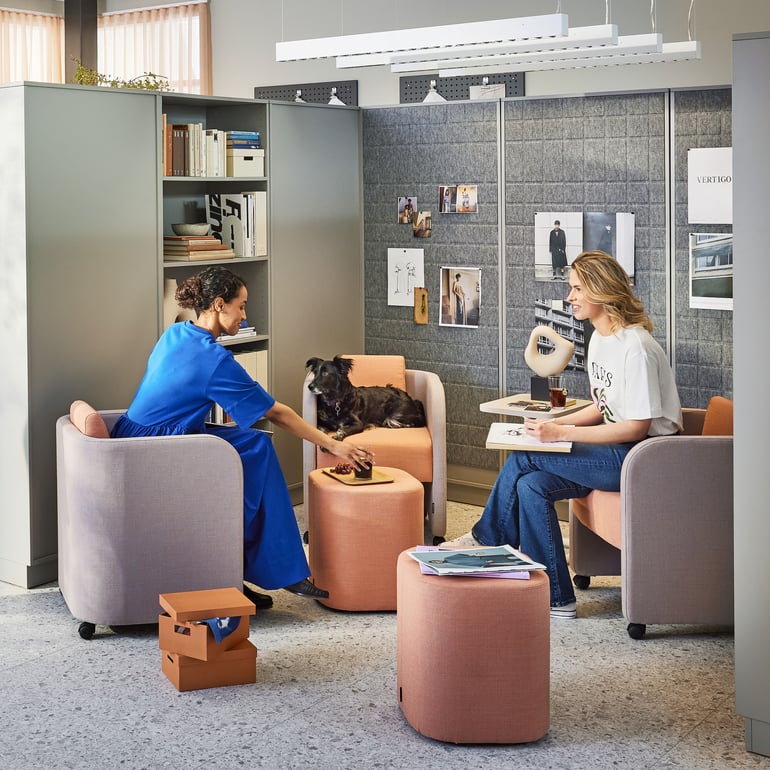
At AJ Products, we supply furniture and equipment for a wide range of workplace environments. Our range includes everything needed to create comfortable break spaces, from welcoming lounge areas for a quick break between meetings to quieter spaces where employees can relax and enjoy some privacy.

In recent years, there has been a growing awareness of the importance of taking breaks during the working day. A well-designed workplace should offer a mix of social spaces and quieter areas, giving employees the freedom to take a break in a way that suits them.
"We want to help create workplace environments that support recovery and cater to different needs," says Elisabet Nilsson, Product Manager at AJ Products.
Workplace culture plays a key role in taking breaks
However, providing the right spaces isn't enough to ensure employees actually take breaks. Workplace policies and expectations also play an important role. Employees need manageable workloads and time set aside for breaks, as well as a workplace culture where taking time out is encouraged and accepted.
"In some workplaces, there's still an attitude that taking a break means you're not working hard enough," says Lina Ejlertsson.
"A crucial point is that simply telling employees to take a break isn't enough. You need to look at the workplace culture and ask: how do we view taking breaks? If a manager never takes a break themselves, they send mixed signals", says Lina Ejlertsson.
When employees have the opportunity to take breaks during the working day, the benefits extend beyond the individual. They can also have a positive impact on how the whole team works together.
"At team level, we can see clear differences in the working environment. It can become more open and supportive when taking breaks and making time for recovery are encouraged."

Micro-breaks everyone can start today
Short breaks throughout the working day can make more of a difference than you might think. According to Lina Ejlertsson, micro-breaks can help us recharge and reduce the physical and mental strain that builds up during the day. The important thing isn't how long the break lasts, but making time to take one.
- Take a few moments to look out of the window.
-
Stand up and have a stretch
- Step away from your desk or usual workspace for a moment.
-
Take a few deep breaths
-
Have a chat with a colleague about something other than work