- AJ Products IE
- Blog
- Buying guides
- Guide to shelving and racking
Types of Pallet Racking and the Differences Between Racking and Shelving
What is Pallet Racking and How Does it Work?
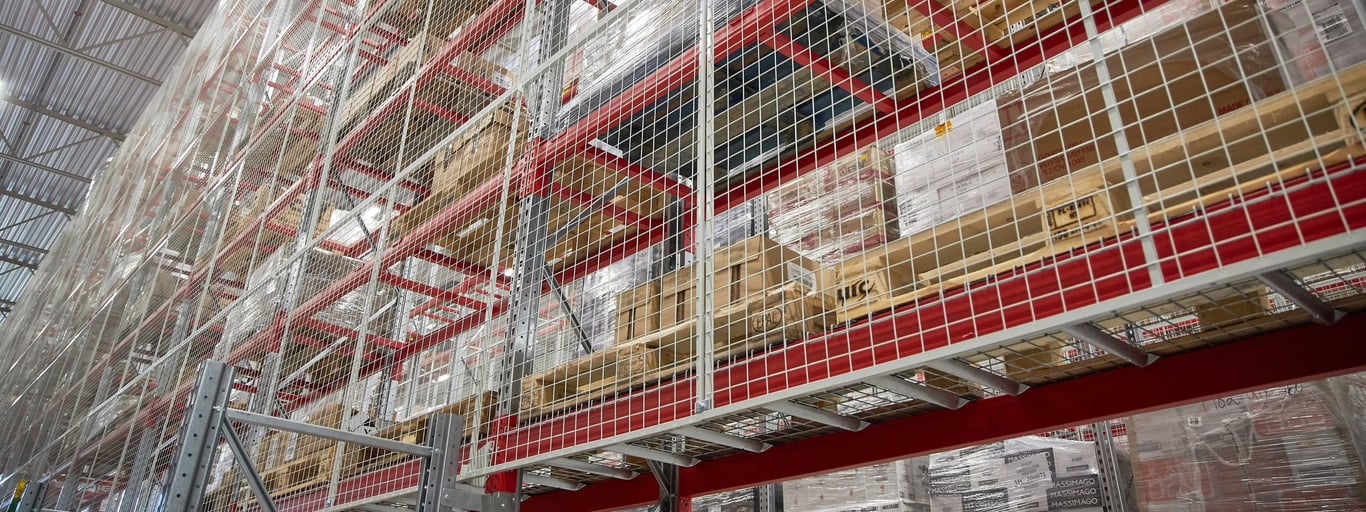
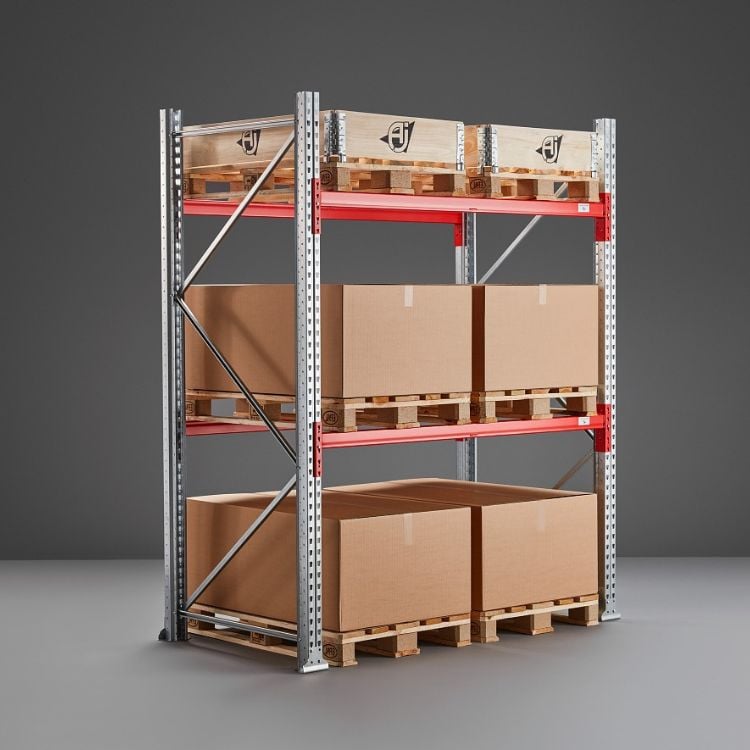
Pallet racking is a vertical warehouse storage system designed to hold heavy goods stored on pallets. Commonly used in industrial environments, it helps businesses increase storage capacity without expanding floor space.
A standard pallet racking system is built from upright end frames and horizontal beams, with pallets resting directly on the beams. This makes it ideal for bulk storage of palletised goods across multiple levels. The best racking system comes down to your load type, warehouse space, and access needs. If you need help choosing the right industrial racking and shelving solutions for your business, contact our project sales team today for advice.
There are also different types of pallet racking designed for specific storage needs. If you are wondering what cantilever racking, wide aisle racking, or Very Narrow Aisle (VNA) pallet racking is, read on.
Types of pallet racking
Different types of pallet racking systems have been developed over time to suit the needs of modern warehouses and factories. Some are designed for specialised goods, while others support tighter layouts where space is limited. These include:
Wide aisle racking
This is the most widely used pallet storage system across almost every industry. It provides direct access to every pallet and can be easily adapted for different stock types. With adjustable beams, the racking can be reconfigured as the size, weight or type of goods changes over time. However, as it requires wider aisles for forklift access, it takes up more floor space and may not be the most compact option.
Best for storing: Mixed pallet loads, cartons, packages, building materials, stock
Double deep pallet racking
Based on the wide aisle racking system, double deep pallet racking increases storage capacity by reducing the number of forklift aisles. Bays are positioned back-to-back, allowing pallets to be stored two-deep on each side, giving up to four pallet spaces per aisle.
Its main advantage is higher storage density within the same floor space, making it ideal for uniform pallet loads stored in volume. However, because pallets sit in deeper lanes, the first pallet loaded is usually the last to be picked, so it is less suitable where strict stock rotation or direct access to every pallet is needed.
Best for storing: Bulky goods, large boxes, FMCG stock
Very narrow aisle racking
Unlike the two racking systems above, the Very Narrow Aisle (VNA) pallet racking is designed for warehouses where space is limited. It reduces aisle width to make better use of available floor area while maintaining vertical storage capacity. The main disadvantage is that it requires specialist narrow aisle forklifts, which can add extra equipment cost and operating requirements.
Best for storing: Fast-moving stock, spare parts, boxed goods, electronics
Cantilever racking
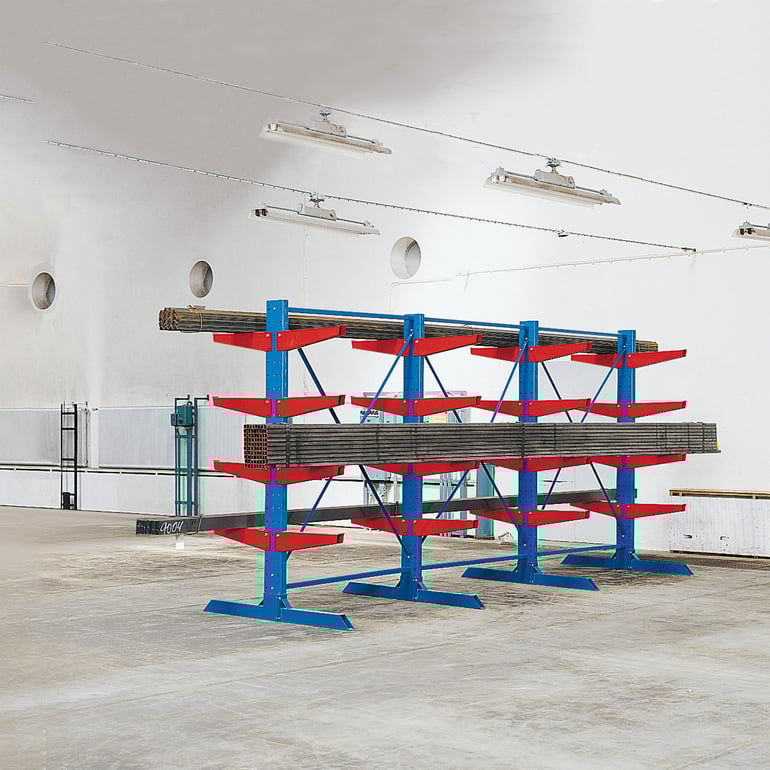
Cantilever racking is specifically designed for long, awkward or oversized goods that won’t fit on traditional pallets. Instead of vertical frames with horizontal beams, cantilever systems use a series of strong uprights fitted with outward-facing arms. These arms support the load from beneath, leaving the front of the rack completely open for easy loading and unloading.
Because there are no front columns, forklifts can access items of varying lengths without obstruction, making it a practical solution for products that are difficult to store on conventional racking. Cantilever racking can be single or double-sided, and arm heights can often be adjusted to create bespoke storage levels as stock requirements change.
While incredibly versatile, cantilever systems do require careful planning to ensure they can safely support the weight and size of the goods being stored. They also tend to take up more lateral space compared to standard pallet racking, so they are best suited to warehouses with enough width to accommodate long loads.
Best for storing: Timber, pipes, steel bars, panels, sheet materials, furniture
Cable reel racking
Cable reel racking is designed for storing cable drums vertically on a pallet racking-style frame, helping save floor space and keep reels easy to access. It’s widely used in electrical and communications storage. The main benefit is its compact, organised setup, but it is specialised for reels and less flexible for general pallet loads.
Best for storing: Cables, chain, cord, boat cable, rope, electrical cable
At AJ Products Ireland, we supply heavy-duty steel pallet racking in a range of sizes. We also offer add-on units and complimentary racking accessories, making it easy to extend existing racking systems and maintain them over time.
Differences between pallet racking and selving
The main difference between pallet racking and warehouse shelving is how goods are stored and handled. Pallet racking is built for heavier palletised loads and is accessed using forklifts or pallet stackers. Industrial shelving, on the other hand, is typically designed for smaller items, stock and equipment that need regular manual access.
In addition, while pallet racking is most used in warehouses and distribution centres, industrial grade shelving is more flexible and can be used across stockrooms, workshops, retail spaces, and various industrial environments. For instance, shelving for builders’ merchants are especially useful for storing trade items like fixings, boxed tools, and building supplies.
- Chemical storage shelving – suitable for storing hazardous substances safely
- Retail shelving – designed for shop floors, displays, and merchandising areas
- Small parts shelving – supplied with bins or boxes for organising fixings and components
- Standard or heavy duty warehouse shelving – versatile options for general storage in stockrooms and work areas
Many warehouses combine pallet racking and shelving, using pallet racks for larger pallet loads and shelving for smaller goods and picking areas. Understanding the difference between racking and shelving is important when selecting the right setup for your operation. Looking for inspiration? Find out more about different pallet racking warehouse layouts.
Questions to ask yourself when choosing a shelving system
1. How much space do I have?
Make sure you have measured the height, width and depth available. If you are storing pallets, check that the pallet racking you have selected fits the pallet size you are using. Most of AJ’s pallet racking is 1100 mm deep and designed for standard 1000 x 1200 mm EUR pallets.
2. How much weight do the shelf levels have to hold?
One of the most important factors to consider is how much weight each shelf level will need to hold. Both shelves and beams are designed for Uniformly Distributed Loads (UDL); this means that the shelf can support the specified weight capacity only if the load is evenly spread across the length of the shelf level. A single item of the full weight capacity placed in the centre of the shelf may cause the shelf to collapse. We recommend that you choose a slightly higher capacity than you need to ensure that the weight is fully supported.
3. Do I need beams of shelves?
Pallet racking is supplied with beams but no shelf support in between and is suitable only for storing pallets, which act as the shelves to bridge the gap between the beams. If you need to store boxes or other non-palletised goods then you will need shelving with a full shelf level; for intensive warehouse use we recommend heavy duty shelving with a suitably high load capacity.
4. Do I need access from one side or both?
Take into account whether or not the shelving needs to be positioned against a wall and whether cross-bracing is required to keep the unit stable (which will prevent access from one side). Pallet racking and heavier duty shelving can generally (but not always) be accessed from either side.
5. Where is my shelving going to be placed?
You should consider what kind of environment your shelving is going to be used in as it may affect the type of finish you should choose. If your shelving system is for a dry indoor environment then a simple powder-coated (or lacquered) finish is suitable. A galvanised finish is rust proof and suitable for damp areas while stainless steel can be washed down and is ideal for use in sterile environments and food storage and preparation areas. Chrome will give a smart but relatively inexpensive finish on lighter-duty shelving (compared to stainless steel for example) and is ideal for display purposes.
6. Will I need more shelving in the future?
Most shelving systems are designed so that they can be easily extended in future. As long as the shelving you buy is sold as basic and add-on units then you will be able to add to it whenever you need to!
Click here to see our Guide to building your racking.

More questions?
If you have any more questions or need a hand with space planning, our expert project sales team is ready to help! We can advise you on the most suitable racking or shelving, put together a floor plan and even arrange a site visit if required. Email: projectsupport_ie@ajproducts.ie or call: 01 2811700
FAQ
- While pallet racking can be considered a type of material racking, material racking is more of an umbrella term that covers many different racking systems. Pallet racking is a more specialised option, as it is designed only for palletised goods. Material racking, on the other hand, is often used for storing different types of loads in varying sizes and lengths. For example, cantilever racking is a heavy-duty system designed for safely storing long materials such as piping, steel bars, sheet materials or timber. Our vertical racking systems also store long items upright and are ideal for pipes and profiles, while sheet material racking is wider and designed for storing flat materials such as boards and panels.
- Pallet racking should be inspected at least annually by an independent specialist to ensure it remains safe and meets industry standards. Safety checks should also be carried out when racking is first installed and after any major damage or changes. Routine inspections should be recorded and completed by a trained person on site.
- At AJ Products UK, each pallet racking product includes clear dimensions and weight capacity specifications in the product description and instruction manual. Load limits are also indicated, with many racks rated around 500kg to 1000kg per pallet depending on the system. However, loads should always stay within the safe working limits and be clearly displayed on the racking load notice to support safe handling by warehouse staff.